What Is Film Photography? A Complete Guide
What is film photography? Compare its look with digital, decode image-quality specs, weigh real costs, and find the gear and services you need to start.

Chapters
In short
Film photography captures light on a light-sensitive strip of film, which is chemically developed into negatives, prints, or scans. Because each frame costs money and cannot be reviewed immediately, it encourages careful composition and patience, while film stocks shape the image’s grain, color, and tone. Film can offer a tactile, distinctive look and lasting physical negatives, but digital is usually faster, easier to edit, and better when you need many reliable images on a deadline.
Ever found an old camera in a drawer and wondered what was still inside? That curiosity sits at the heart of film photography.
Instead of recording light as digital data, a film camera captures it on a strip of light-sensitive film, and a chemical process later turns that exposure into a visible image. How sensitive that film is to light is the idea behind ISO photography.
In this post, we’ll cover how film works, the main film types, the shoot-to-print workflow, and why so many people still choose it. Then we’ll show you how film’s look and habits can sharpen your own video and stills.
What Film Photography Is and Its Revival
Film never fully left, but it’s back in a big way. Here’s what’s behind the comeback.
Why film is popular again
Interest in analog photography, which captures images on physical film, has grown fast. A study titled Understanding the New Analogue Photography notes that Eastman Kodak and Fujifilm are offering film products again.
Labs are reappearing too. WINK News reported that On a Roll Film Lab in Naples moved into a bigger space to meet the growing need for developing and scanning film.
Younger shooters are a big part of it. Fortune notes that within the past five years, younger people have been increasingly drawn to the old way of doing photography.
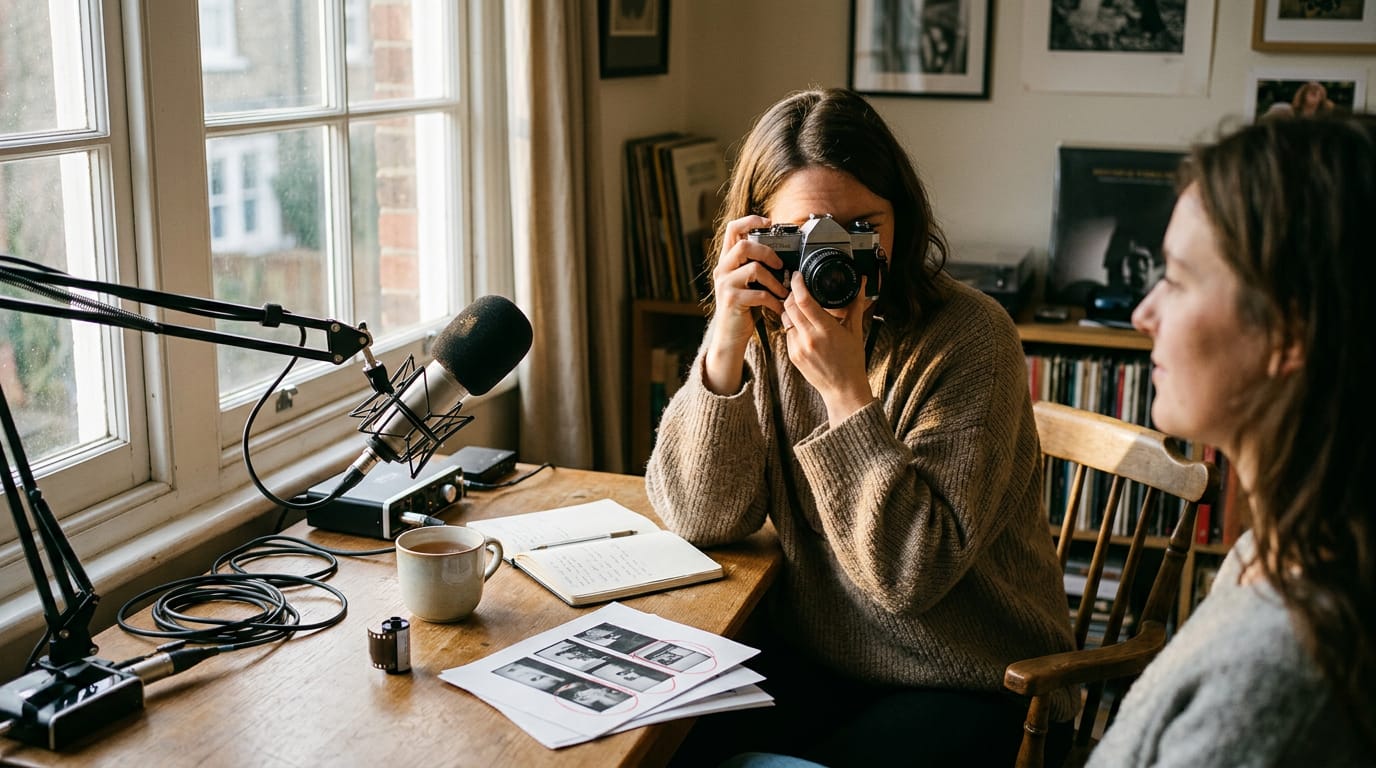
Then there’s the subculture and its social media look. Picture a podcast host who posts a grainy weekend roll that looks more human than her polished thumbnails. Imperfection is the appeal.
Retro appeal and whether it will last
Much of the pull is retro, like the vinyl comeback. The warm, carefully framed look of Wes Anderson’s films has pulled people toward film too, and analog synths have followed a similar path.
Not everyone’s convinced it’ll last. Skeptics ask whether a hobby built on film and nearby labs can outlast the novelty. Is it a passing trend or a lasting practice?
How film gets covered in gear talk
Film coverage can feel niche next to mainstream gear reviews. When you read something from Fstoppers, look for balance: does it weigh film’s costs and limits against its look?
Some shooters feel the conversation is gatekept, with veterans dismissing newcomers’ choices. Others say coverage leans too hard on nostalgia. Weigh both before you decide what to trust.
How Shooting Film Differs from Digital
Photography in simple words is capturing light so you can see it later. Film does that with light-sensitive material, which shapes every frame you take.
Slowing down and thinking before you shoot
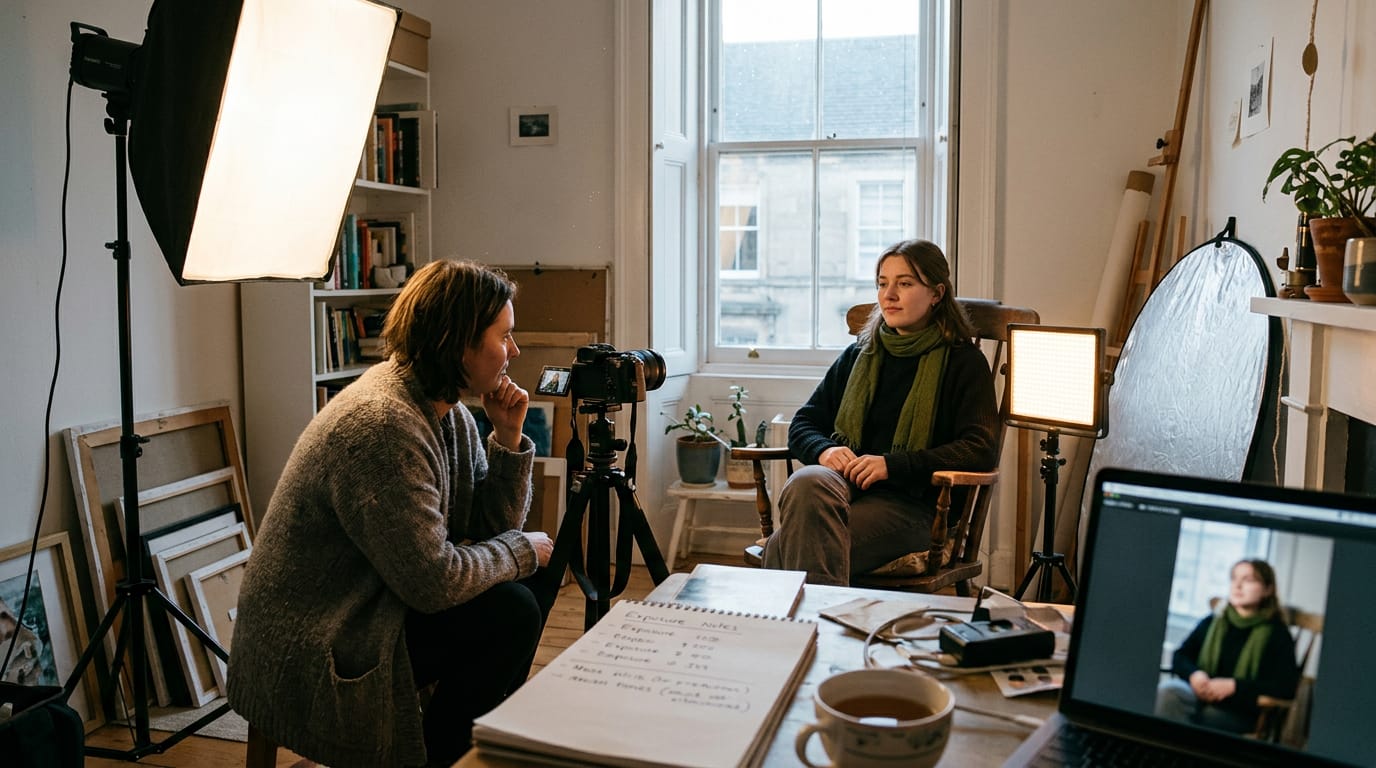
Film gives you limited frames, so every click costs something, and that forces care. Picture a solo podcaster shooting a cover photo: instead of firing off dozens of shots, she takes two or three frames she’s sure of.
Think about each shot before you take it. It’s less about how many pictures you take and more about how carefully you take them. Brain over gadget: your eye picks the moment, so you stay more present with your subject. Careful beats constant.
Keeping gear simple and hands-on
Fewer controls and settings keep your attention on light and composition. Your results are physical, too: a negative you can hold to the window and prints you can pin up.
That helps you escape gear chasing, the habit of believing the next upgrade will fix your pictures. It’s like fly fishing: an angler works with a few flies and makes each cast count. Film means less to adjust and more to notice.
Digital can mimic that simplicity with film-style modes.
Enjoying the wait, the darkroom and learning
Waiting for results builds anticipation. For many people the darkroom is the best part, a red safelight and a print slowly rising in a tray. It works like therapy and teaches you to read light and color before you shoot.
Then there’s the lab return, when a roll of scans feels like a small gift.
A real estate agent who spends an evening in the darkroom learns how window light falls across a kitchen counter, then sets her video tour lights the same way. The waiting is the lesson. If you want to set lights like she does, start with continuous light photography.
Using film alongside your digital camera
You don’t have to pick a side: hybrid shooting means using both, each for what it does best. Keep digital for critical moments you can’t afford to miss, like a live stream’s opening or a client’s signing.
Film works as a backup option too, since a memory card can fail while a roll you’ve already shot is safe. The two coexist well, and we’d keep both in your bag.
A wedding videographer might shoot the ceremony digitally, then use a few film stills as B-roll (the cutaway shots you layer over your main footage) or as a grainy thumbnail.
Image Quality and What the Specs Mean
Film captures an image when light changes a light-sensitive layer, so that layer’s size and chemistry shape the result. Here’s what that means for your shoot.
Detail across different film sizes
Large format film records a huge amount of fine detail, which suits gallery prints. Medium format is prized for tonality, the smooth shift between shades.
Newer fine-grain stocks keep grain small, and digital resolution rivals film for screens and web work. Some photographers still make showpiece prints with wet printing, developing paper by hand in a darkroom.
How film handles highlights and shadows
Film is often called built-in HDR (high dynamic range, holding bright and dark areas together), a loose label. Negative film is forgiving, while chrome (slide film) has narrow latitude, or room for error, so exposure has to be close.
Contrast is set in development, through time and chemistry. Digital highlight blowout is the flip side: bright areas go to flat white. There’s no detail left to recover.
A podcaster filming beside a bright window may watch that window go white on digital, while negative keeps more of its detail.
Why people love the film look
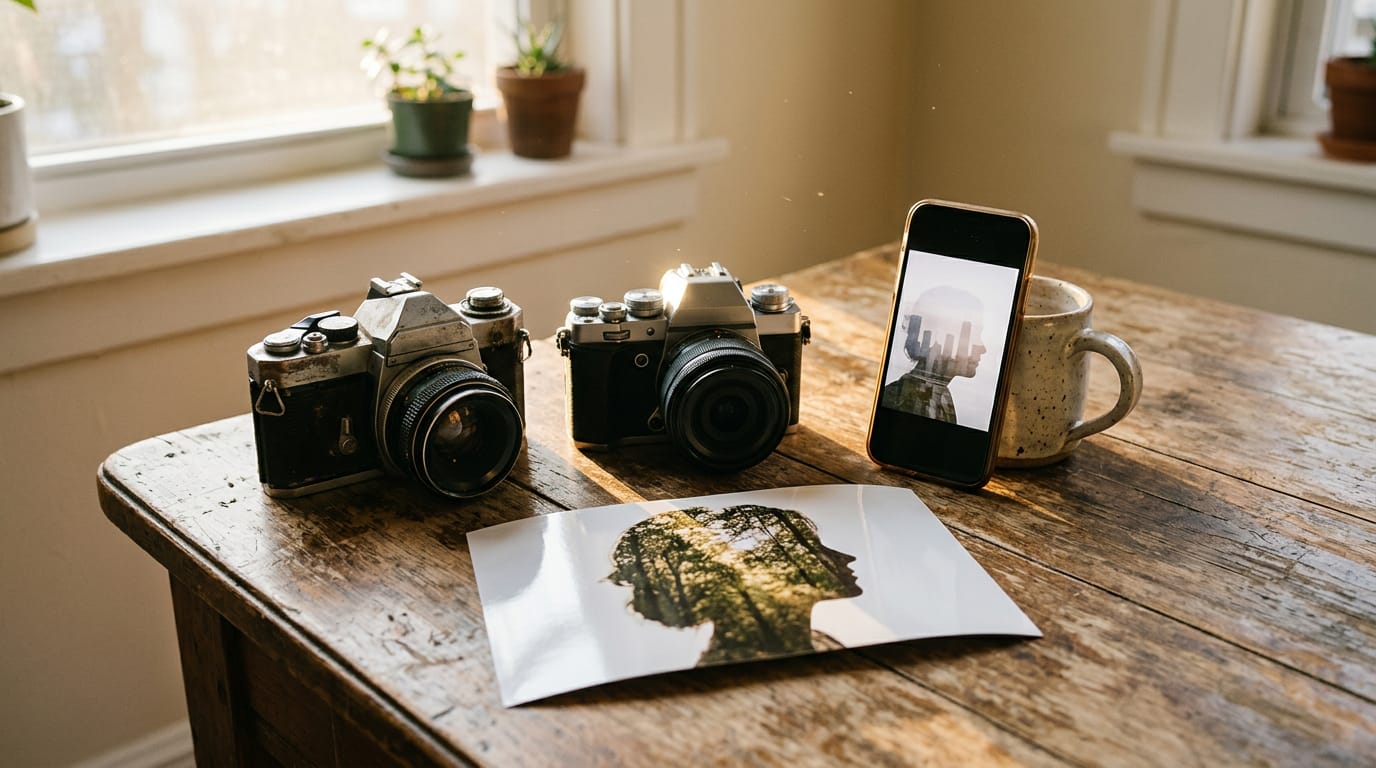
Grain is the texture most people mean by the film look. Digital emulation uses filters and presets to copy that grain and color on digital footage. Much of the draw is authenticity and feel: every shot feels deliberate.
Each stock renders skin and color with its own character. Colorists apply film looks in video grading. A wedding videographer might grade every clip to one stock so skin tones match all day.
Testing your own exposure and metering
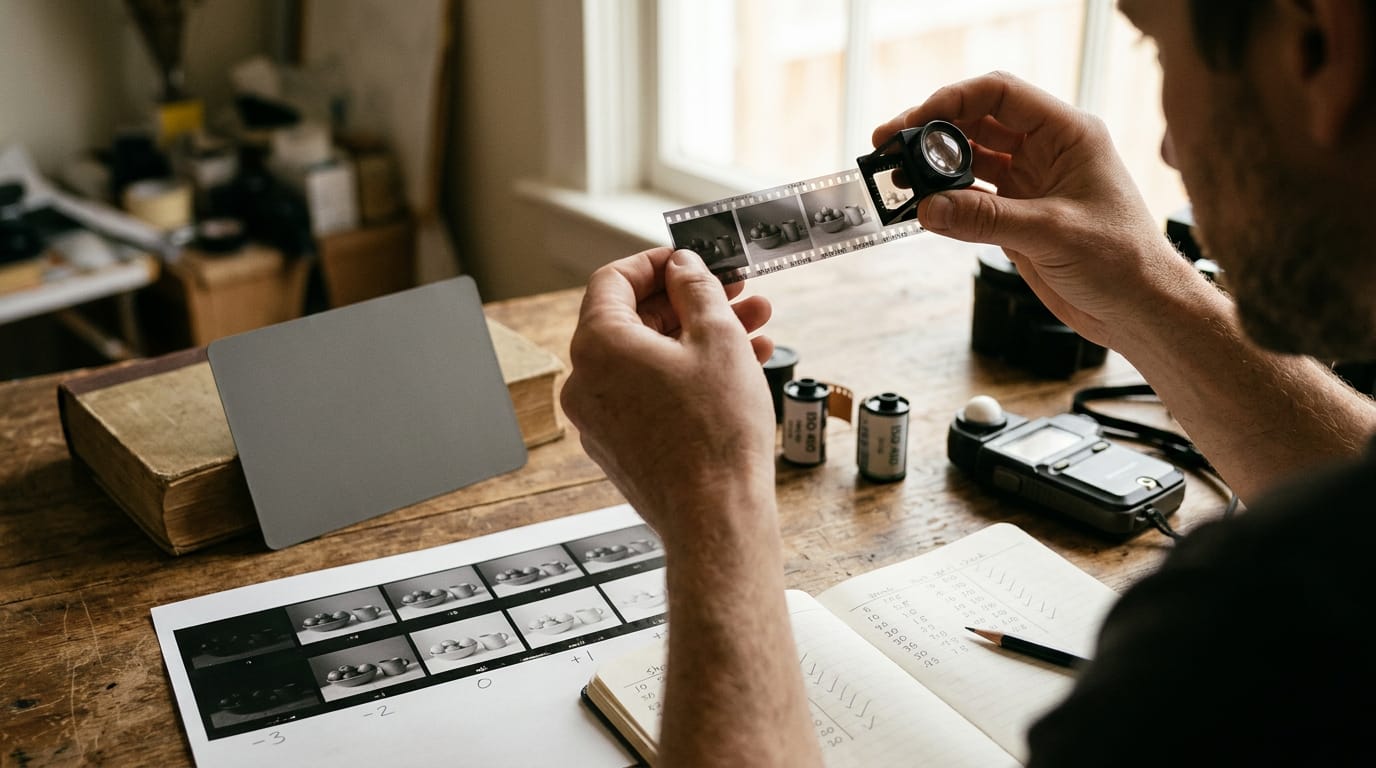
A spot meter reads a small area of the scene. The Zone System breaks a scene into numbered tonal steps. The 20-60-20 rule is a rough check that splits a frame into about 20 percent shadows, 60 percent midtones, and 20 percent highlights.
Run these checks before you trust a roll:
- Base ISO testing. Shoot at the film’s base ISO (its native speed rating), then test a few settings.
- Film stock consistency. Stick to one stock and batch, since a new batch can shift color.
- Lab scanning limitations. Labs often auto-correct color, so the scan may not match your exposure.
- Own scans for control. Scanning yourself lets you set color and contrast, so you see what the negative holds.
The Real Costs and Downsides of Film
Film has real trade-offs worth knowing before you commit. Here’s where it costs you money and patience, and where digital still wins.
What you’ll pay for gear and film
Cheap used film cameras are easy to find, but film is cheap to start and pricier to keep going. Every frame carries a per-frame cost, and developing can be pricey too. Digital bodies, meanwhile, often cost thousands up front.
Picture a solo streamer shooting a few rolls for her channel artwork: every throwaway test frame is one she paid for.
Where film can hold you back
Film offers no instant review, so you can’t check a shot right away. A study on personal digital photo activities points out that digital cameras let you judge a picture on the spot and retake it if it isn’t good enough.
Film also has no dual-card redundancy, the backup copy some digital bodies make by writing to two memory cards at once.
A once-in-a-lifetime moment, like a surprise toast at a family reunion, won’t wait for a second try. In fast action, you’ll get fewer keepers, the frames worth keeping, because each roll offers only so many tries.
Some people also find the wait maddening, especially a creator who needs clips for social media the same afternoon.
Film survives loss and needs no power
A negative, the developed strip that holds your images, is hard to lose. A digital file, by contrast, can vanish with one wrong click or a corrupted drive.
Film also needs no electricity to hold your images, so a dead battery or power cut can’t erase a roll that’s already exposed. Film is simply safer.
Where digital still pulls ahead
Digital keeps the edge in a few areas:
- Freedom from constraints. You can change settings between shots without counting the frames left on a roll.
- Post-production manipulation. Editing after the shoot, like adjusting exposure, color, and cropping, gives you far more room to work.
- More keepers. Shooting more and reviewing as you go means more frames you’ll actually use.
- Better for wildlife and professional work. A wildlife photographer tracking a bird in flight, or a real estate agent shooting a listing on a tight deadline, needs that speed.
- Marketable output. Digital files are easy to edit, resize, and send, which matters when a client needs images by Friday.
Gear and Services to Start With
Starting with film doesn’t take a closet full of gear, just a camera that fits your budget, a format that suits how you shoot, and a lab you trust.
Choosing cameras, lenses and instant film
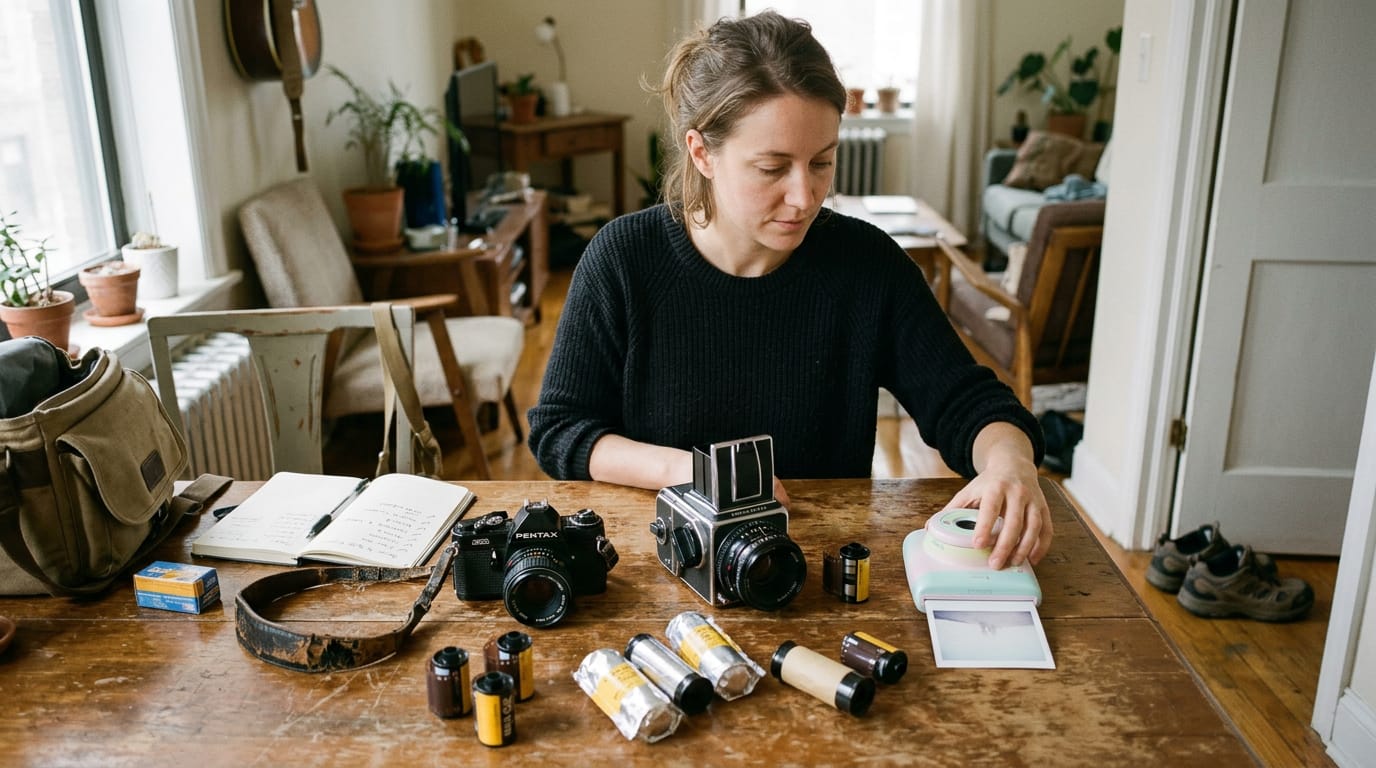
Pentax and Minolta single-lens reflex (SLR) cameras are an easy place to begin. You look through the same lens that takes the picture, and many are sturdy, mechanical, and easy to find secondhand.
The Contax 645 is the step up. It’s a medium format camera that records a larger image for finer detail, but it costs more.
Instant film has had a revival, and an instant camera prints within minutes, though each shot is a one-off with no film to reprint.
Choose your format by how you’ll shoot, not by looks. 35mm is the common small roll, while 120 is a medium format roll with bigger frames.
For film type, color negative handles everyday color, black-and-white adds contrast, and slide film gives a positive image you view directly.
Getting film developed and finding ideas
Here’s the roll-to-print path:
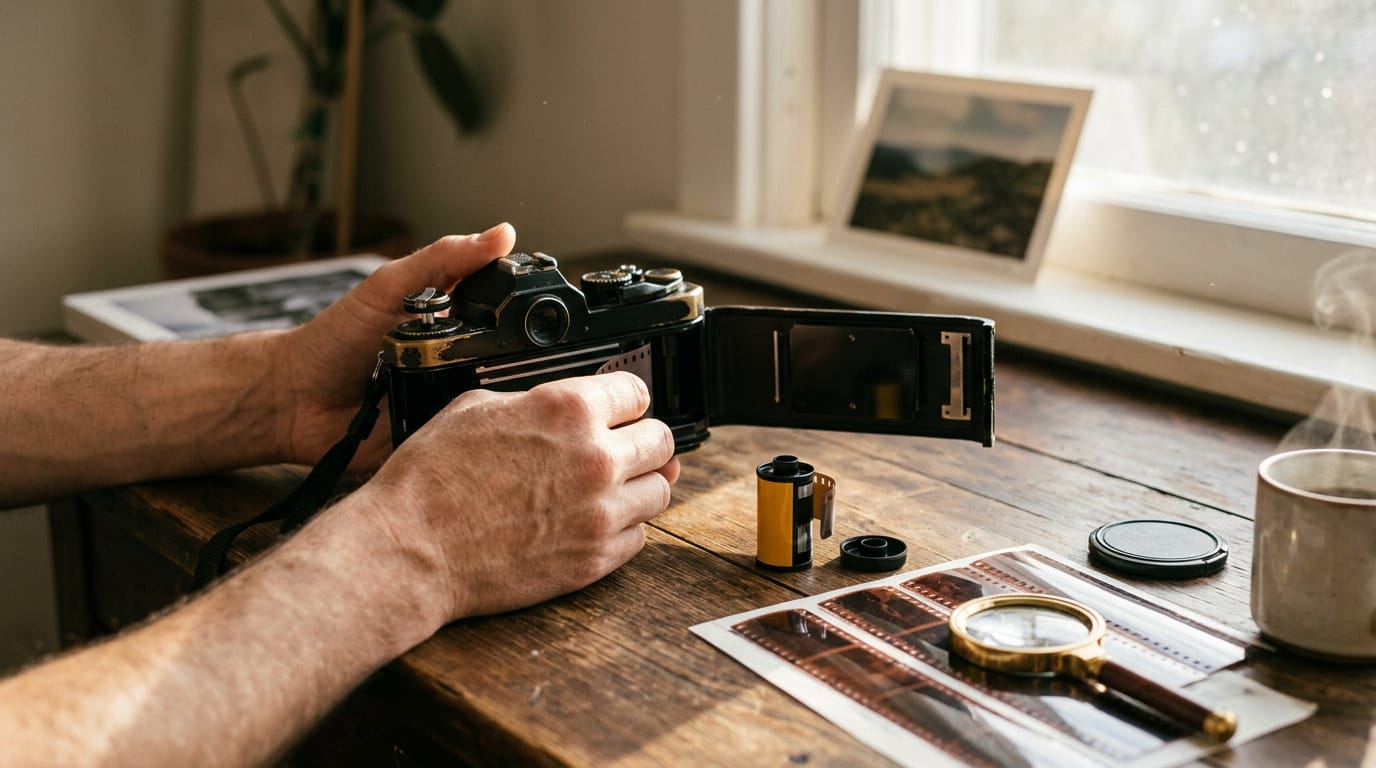
- Rewind the roll fully before you open the camera.
- Send it to a local or mail-in developing service and ask for prints, scans, or both.
- Pick your strongest frames from the prints or scans.
- Print or edit the keepers.
Follow a few film wedding photographers for ideas. Picture a home-office creator who studies how they use a window for soft, even light, then reuses that setup for her talking-head videos without buying a lamp.
Shoot a short series for your blog. The seven basics of photography include:
- exposure
- composition
- light
- focus
Film makes each one more deliberate. Film asks you to anticipate the frame, not chase it. Patience is part of the kit.
Film Photography for Pros and Business
Working photographers still book film for paid jobs, and we’ll show you where it fits.
Shooting weddings on film
A wedding photographer might shoot the ceremony digitally for speed and the reception on film for warmth, a hybrid approach that blends both in one job.
For the film half, choose a color negative stock with forgiving exposure, since candlelit tables and bright windows can share one afternoon.
Secondhand SLRs (single-lens reflex cameras, where you see through the lens that takes the picture) are affordable starters.
Film does best in daylight. Set your subject near a window, facing the light, the same way you’d place a key light at home. Use what’s already there.
Pitching film as a selling point
Film gives your pitch four selling points:
- Classic, timeless look. Its soft grain and gentle color don’t date the way a trendy filter can.
- A real differentiator. When every studio offers the same digital package, film is something specific to name.
- Artistic process appeal. Clients respond to craft, shifting focus from how many frames you fire off to how well you frame each one.
- Safety from image loss. A negative is physical, so a corrupted memory card can’t erase it. Store it somewhere cool and dry.
How pros put film to work
- Gallery prints and the art market. Galleries show film prints to buyers who value the medium itself.
- Agencies choosing film. Some agencies specify film when a campaign needs a particular look.
- Travel and expedition shooting. Film rolls pack light. A thesis on Rosemary Gilliat Eaton’s 1960 Arctic trip describes her shooting thousands of images for professional assignments and personal use.
- Backup film bodies. A spare film camera keeps the shoot going if your digital body fails.
Film photography boils down to a simple idea: light hits a chemical layer, and the process turns that exposure into a picture you can hold.
The slower pace, the limited frames, and the wait for prints teach habits that digital makes easy to skip, like framing with purpose and committing to a shot.
Those habits carry over to your video and stills, whether you’re lighting a bedroom set or a product table. Shoot with intention, and the picture will show it.
References
- Understanding the New Analogue Photography: Meanings, Methodologies and Aesthetics — doi.org (2023)
- Photographic Encounters in the North: Rosemary Gilliat Eaton’s 1960 Trip to the Eastern Canadian Arctic — doi.org (2016)
- From PhotoWork to PhotoUse: exploring personal digital photo activities — doi.org (2017)
- On a Roll Film Lab in Naples grows as young people embrace film cameras — winknews.com (2026)
- Gen Z’s analog obsession is reviving a film camera market that digital killed — fortune.com (2026)
Questions
What is photography in simple words?
Photography is capturing light to create an image you can see later. A camera records that light, either digitally or on light-sensitive film.
What is the 20-60-20 rule in photography?
The 20-60-20 rule is a rough way to think about tonal balance in a frame: about 20 percent shadows, 60 percent midtones, and 20 percent highlights. It is a guideline, not a strict requirement for every photograph.
What are the 7 basics of photography?
Seven basic photography concepts are exposure, aperture, shutter speed, ISO, focus, composition, and light. Together, they help you control brightness and sharpness and decide how the image is framed and lit.
Why do people do film photography?
People do film photography for its distinctive grain and color, the hands-on process, and the anticipation of seeing developed images. Limited frames also encourage photographers to slow down, pay attention, and make each shot deliberate.
Sources
- Understanding the New Analogue Photography: Meanings, Methodologies and Aesthetics, doi.org,
- On a Roll Film Lab in Naples grows as young people embrace film cameras, winknews.com,
- Gen Z's analog obsession is reviving a film camera market that digital killed | Fortune, fortune.com,
- Photographic Encounters in the North: Rosemary Gilliat Eaton's 1960 Trip to the Eastern Canadian Arctic, doi.org,
- From PhotoWork to PhotoUse: exploring personal digital photo activities, doi.org,