ORTF Microphone Technique: How Two Mics Capture Stereo
ORTF microphone technique pairs two cardioid mics 17 cm apart at 110° for natural stereo, with comparisons and a home-video mounting setup.

Chapters
In short
ORTF is a near-coincident stereo microphone technique that uses two matched cardioid mics spaced 17 cm apart and angled 110° from each other. This arrangement captures both loudness and timing differences, creating a spacious, accurately positioned stereo image that works especially well for room ambience and diffuse sounds. Use it when you want a scene to feel open and located in space, but choose a closer mic for center-focused narration or action.
Think about how you pick out voices in a crowded room. Each ear catches them from a slightly different angle, and your brain blends those differences into a sense of space. Two microphones can capture that same effect.
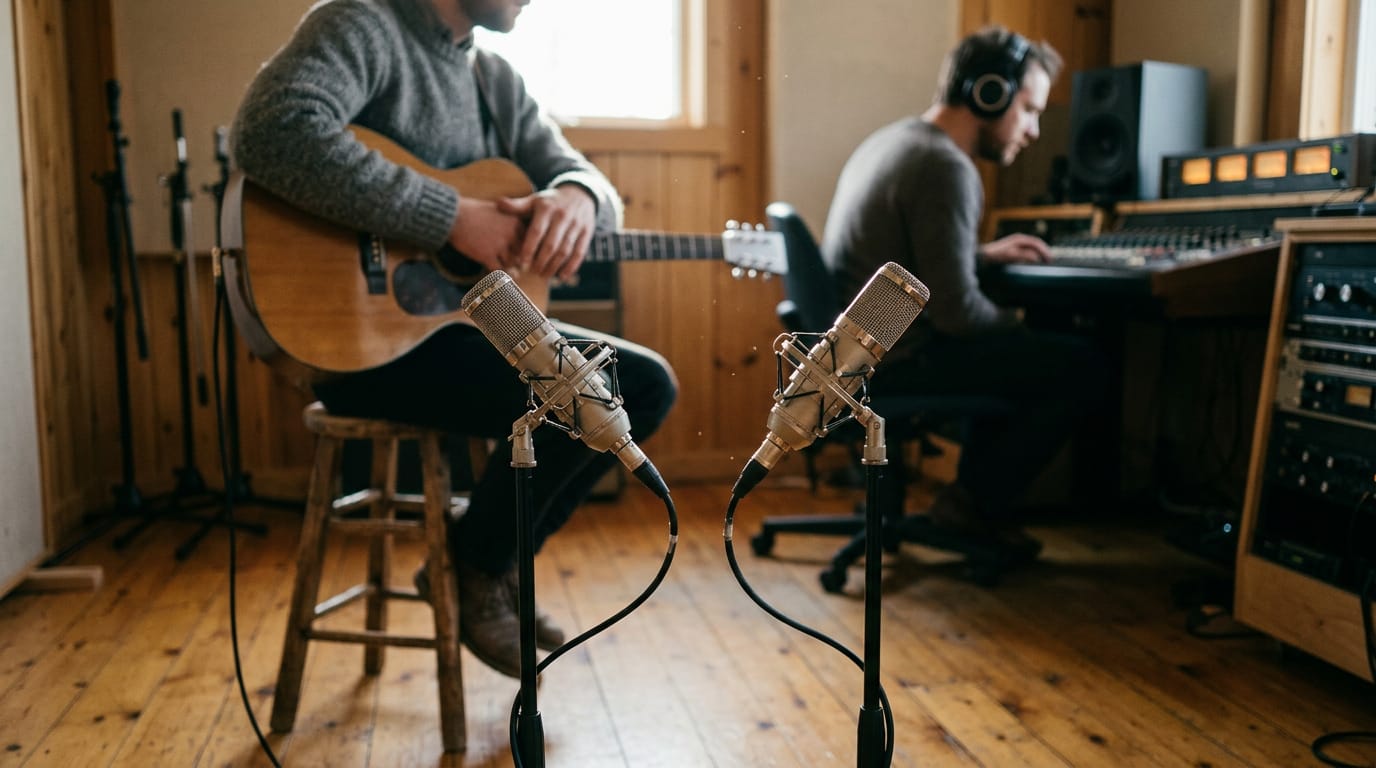
ORTF, short for Office de Radiodiffusion Télévision Française, is a stereo technique that uses two cardioid mics (they pick up mostly from the front) angled 110° apart and spaced 17 cm apart.
In this post, we’ll cover the setup, how it compares with other stereo techniques, and how to place, record, and mount a pair for video at home.
Stereo Miking Basics and ORTF Microphone Technique
Stereo miking captures sound with a sense of place, and a pair of mics placed with care can get you there at home.
Why recording in stereo helps
A mono recording puts every sound in the same spot. Stereo adds position, so sounds can sit left, right, or center. It also captures room ambience, and because we hear with two ears, two channels sound closer to human hearing.
Picture a solo YouTuber filming a cooking video: one mic blurs the sizzling pan into her voice, while a stereo pair lets viewers hear the pan drift to one side with her voice centered. A single voice facing camera often needs just one mic.
How coincident, near-coincident, and spaced pairs differ
Stereo pairs fall into three groups based on how far apart their capsules (the sound-sensing parts inside each mic) sit. Here’s what each group means for you:
- Coincident pairs sit as close together as possible and mostly differ by level.
- Near-coincident pairs, the family the ORTF setup belongs to, sit slightly apart and angled, so level and timing both matter.
- Spaced pairs sit farther apart, so timing does most of the work.
Level differences come from angle, while timing differences come from distance: the same sound reaches each capsule a moment apart. Coincident pairs usually fold down to mono cleanly, while spaced pairs can sound thin when combined.
It’s also a trade between width and focus: wider spacing gives a bigger image, tighter spacing a more focused one.
How timing gaps cause phase cancellation
Timing differences cause cancellation. When the same sound hits two mics at slightly different moments, the waveforms can line up against each other, and peaks meeting troughs cancel out. That’s phase cancellation.
It doesn’t hit every pitch equally: some frequencies get boosted while others get cut, which can leave a voice sounding hollow.
For spaced pairs, the 3:1 rule is the usual guideline: keep the gap between mics about three times their distance from the sound source. Keeping capsules close together is the simplest fix. Less gap, less trouble.
Where stereo miking came from
An Audio Engineering Society paper on early Bell Laboratories work shows that stereo recording was invented before the 1930s, during research by Bell Labs and EMI.
Two mics, two speakers minimum. Stereo needs two channels from capture to playback, so each side gets its own path.
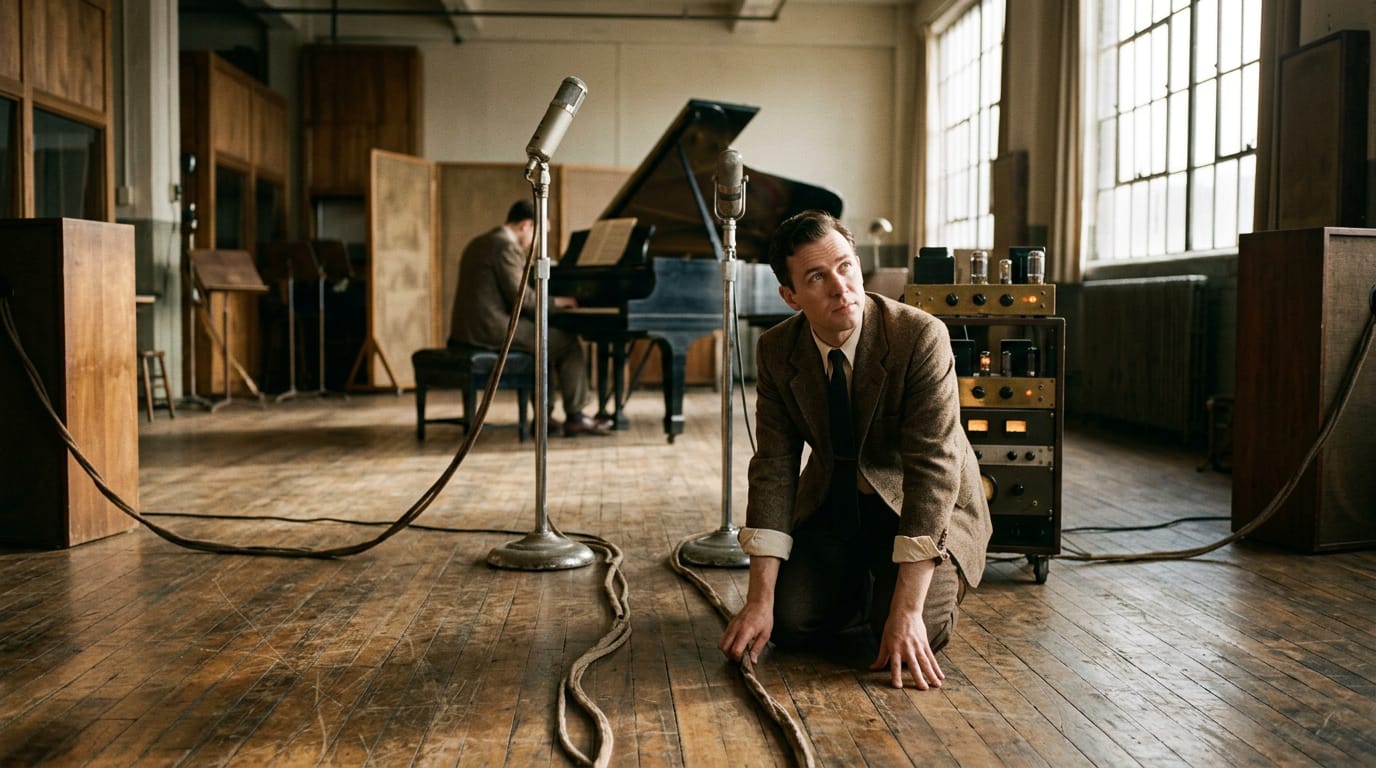
Inside the ORTF Approach
An ORTF pair is two mics, one angle, and one gap. We’ll unpack each part below.
Specs for building an ORTF pair
- Two matched cardioid mics. Cardioids pick up mostly from the front, so you want two identical units.
- 110° angle between mics. A stereo localisation study gives this as the standardized value.
- 17cm (about 6 inches) spacing. A Joy of Music Program promotional sampler describes this gap.
- French broadcaster origin. The technique originated with the French broadcaster ORTF, and Albert Laracine, one of the pair’s inventors, is interviewed in an ECHO project recording.
Set one up like this:
- Mount both mics on one bar so the angle and gap stay fixed.
- Set 17cm between them, angle them to 110°, and aim both at the source.
- Back the pair away until you hear the room as part of the recording.
How ORTF builds a stereo image
The pair picks up a time difference (sound reaches each mic at a slightly different moment) and a level difference (loudness varies between mics). It mimics ear spacing, which gives a wide, spacious image with good positional accuracy.
It’s less about how loud a sound is and more about where it sits.
Where ORTF shines and where it struggles
- Best for ambience. Room tone, crowd noise, and other diffuse sounds are its sweet spot.
- Some mono information retained. Parts of the sound stay centered across both channels.
- Less suited to center-focused action. A center source sits off-axis to both mics.
Consider a course creator filming a walkthrough of a busy workshop. The pair catches the room’s hum and the tools on the bench, so the footage feels like it was shot on location. Narration still needs a closer mic. Right tool, right job.
Other Ways to Record Stereo
ORTF is one of several ways to capture stereo, and each one trades something different. Here’s how we’d sort the main alternatives, so you can match the technique to your room and your mount.
Two spaced mics, called the A-B pair
The simplest option is the A-B pair: two mics set a fixed distance apart and aimed straight ahead. Use cardioid mics, which favor the front, or omni mics, which pick up sound from every direction.
The spacing sets the stereo width, so a wider gap gives an open, spacious sound.
The catch is a weak center and poor mono-compatibility, meaning the image falls apart when both channels are combined into one mono signal. You gain width at the expense of focus.
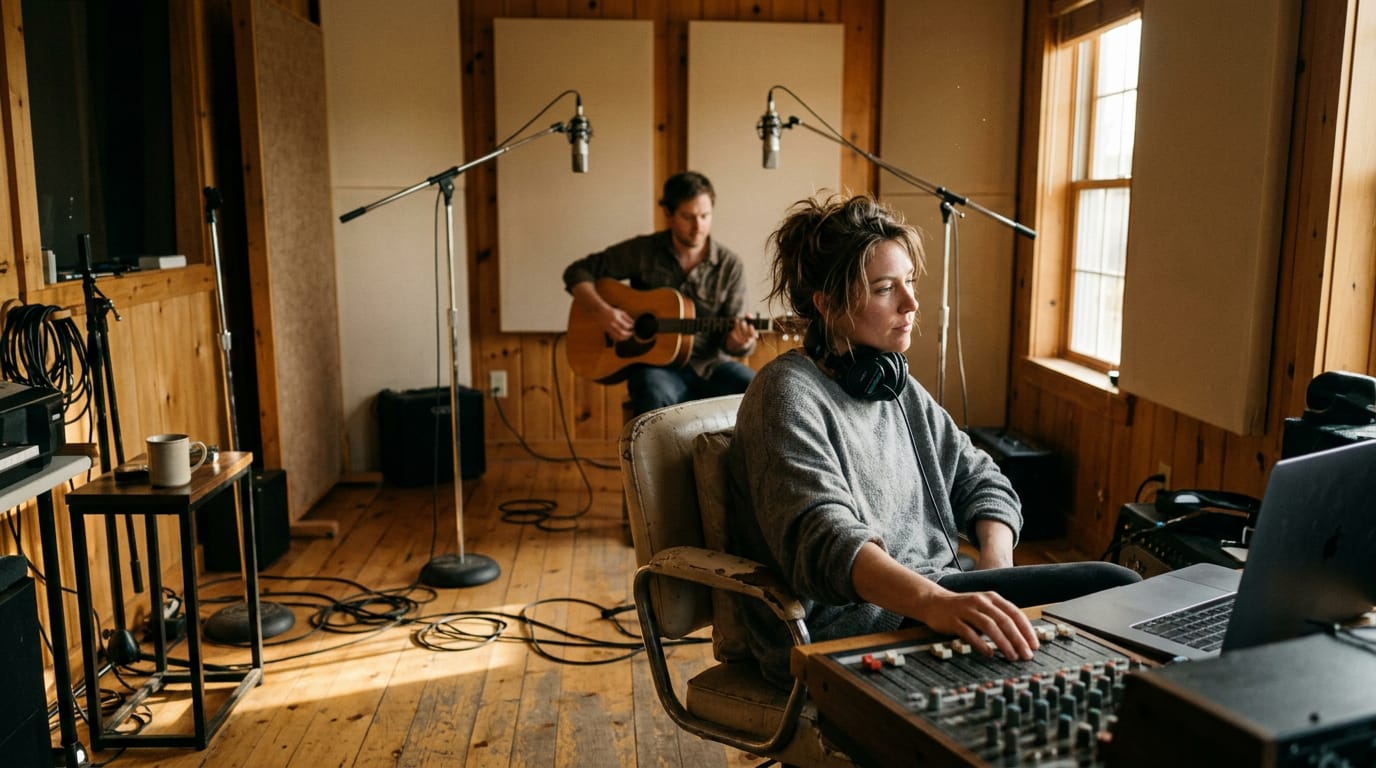
Two crossed mics in an X-Y setup
An X-Y pair places two cardioid mics on the same point, angled 90° apart, so the elements that pick up sound sit as close together as possible. The result is a focused, accurate image.
It’s narrower than ORTF or A-B, so it feels less roomy, but it holds up strongly in mono.
Single-body stereo mics put an X-Y pair in one housing, which suits a podcaster hosting two guests across a small table: one compact mic in the middle keeps each voice in its own spot without a second stand crowding the desk.
Mid-side pairs with width set in post
A mid-side (M-S) pair mounts two mics on one stand: a cardioid facing forward for the middle, and a figure-8 mic aimed to the sides, which picks up both sides and rejects the front and back.
Raw M-S files need decoding, a matrix step that turns the two signals into left and right. Once decoded, you can adjust the width in post.
A YouTuber filming a walking tour can try a narrow mix and a wide mix in the edit and keep whichever suits the street, with no second trip out for the gear. M-S is also mono-compatible and places sounds accurately.
Blumlein pair of figure-8 mics
Two figure-8 mics at 90° form a Blumlein pair. Because each one picks up front and back, the setup captures rear ambience, the room sound behind the mics, along with what’s in front.
It’s lovely in a good room and a problem in a poor one, so pick your space carefully. The back wall is part of the recording.
Binaural recording, best heard on headphones
Binaural recording uses a dummy head, a model of a human head with an omni mic in each ear position, so sound reaches the mics much as it would reach your ears.
The effect is immersive, but speaker playback often falls apart, so it’s best heard on headphones.
A meditation guide who wants listeners to feel like she’s sitting right beside them can get that closeness with this setup, as long as her audience wears headphones. If a dummy head feels like too much, these two options are worth knowing:
- In-ear mics. Tiny mics sit in the ears, keeping the gear out of frame for a presenter who wants a clean shot.
- Baffle pseudo-binaural. A small barrier between two mics mimics the way a head blocks sound, an imitation of binaural that uses simpler gear.
Picking the Right Technique for Each Job
No single setup wins every job, so start with the source, the space, and what the sound needs to do later.
Match technique to source and purpose
Wide pairs spread out to capture ambience, the feel of the room around a sound. A coincident pair, with capsules close together, suits focused effects that need one tight, centered image.
Whether the source is already miked matters too, and personal preference counts: two skilled creators can pick different setups for the same scene, and both can be right.
A solo creator filming a farmers market vlog might pick a wide pair so viewers feel the crowd and stalls around her. Trust your ears.

Field and venue factors that matter
Venue matters too:
- Wind protection. Confirm your windscreen fits the pair before heading outdoors.
- Grab-and-go setup. A compact pair on a small stand gets you rolling fast.
- Limited stand placement. In a tight room, mount the pair where it fits, keeping the 110° angle and 17cm spacing as close as possible.
- Remix later. Pan to taste in the edit, then run a mono check (summing both channels into one) to see if it holds up on a phone speaker.
- ORTF for video. Grab a little room tone (the quiet background of a space) and foley (everyday scene sounds) to smooth edits.
- Syncing to camera. Mark a sync point, like a clap, so the stereo audio lines up with your footage.
Try a few techniques and compare
Don’t commit yet. Record the same short scene with two or three setups, then listen on headphones and on the speakers your viewers use. Keep the one that serves the project, not the one that sounds impressive on paper.
Gear and How to Mount It
An ORTF pair needs less gear than you might expect. It’s less about how many mics you buy and more about how you hold them, so here’s what we’d look for and how to keep the pair steady.
Mics worth considering for stereo
Start with a matched cardioid pair: two mics of the same model, so each one responds the same way, with a cardioid pickup pattern that listens mainly from the front. The other route is a dedicated stereo mic, which packs both capsules into one body.
Rode’s NT4, NT5, and NT55 are worth a look, and Neumann and Sennheiser both offer options if your budget stretches that far.
On budget, one stereo mic means one body, one cable, and one stand. Fewer parts, fewer headaches.
Two matched mics give you more choice, but you’re buying two of everything, and the pair also needs a two-channel interface: the box between the mics and your computer, with two inputs so each mic gets its own track.
Consider a podcaster recording two guests in a spare bedroom. With one stereo mic, she runs one cable, sets one stand, and spends her energy on the conversation.
Accessories that make mounting easier
Mounting keeps the pair consistent from one session to the next. Get it right once. Then keep it that way.
- Stereo bars with ORTF markings. A bar that holds both mics, with markings for the 110° angle and 17cm spacing, so you set it once and skip re-measuring.
- Shure A27M adaptor. One mounting option for holding the pair on a single stand.
- Single stand for two mics. Both mics move as one, so repositioning the stand doesn’t change the spacing or angle.
- Blimp windshield for pairs. A furry cover that cuts wind noise. Each mic needs its own, so budget for two.
With the 110° angle and 17 cm spacing under your belt, ORTF stops being a mystery. You know where it shines, when another stereo technique might suit the job better, and how to mount a pair so it stays put during a take.
Your ears have been doing this job your whole life. Now your camera can too.
References
- Choosing and Configuring a Stereo Microphone Technique Based on Localisation Curves — doi.org (2011)
- Joy of Music Program promotional sampler production. — digitalcommons.wpi.edu (2000)
- Early Hi-Fi and Stereo Recording at Bell Laboratories (1931-1932) — aes.org (1980)
- ANR ECHO Entretien avec Albert Laracine Preneur de son à la radio et l’un des inventeurs du couple ORTF: L’entretien se compose de deux documents: Albert Laracine 1 (1h02’48”) et Albert Laracine 2 (46’12”) — hal.science (2015)
Sources
- Early Hi-Fi and Stereo Recording at Bell Laboratories (1931-1932), aes.org,
- Choosing and Configuring a Stereo Microphone Technique Based on Localisation Curves, doi.org,
- Joy of Music Program promotional sampler production., digitalcommons.wpi.edu,
- ANR ECHO Entretien avec Albert Laracine Preneur de son à la radio et l'un des inventeurs du couple ORTF: L'entretien se compose de deux documents: Albert, hal.science,