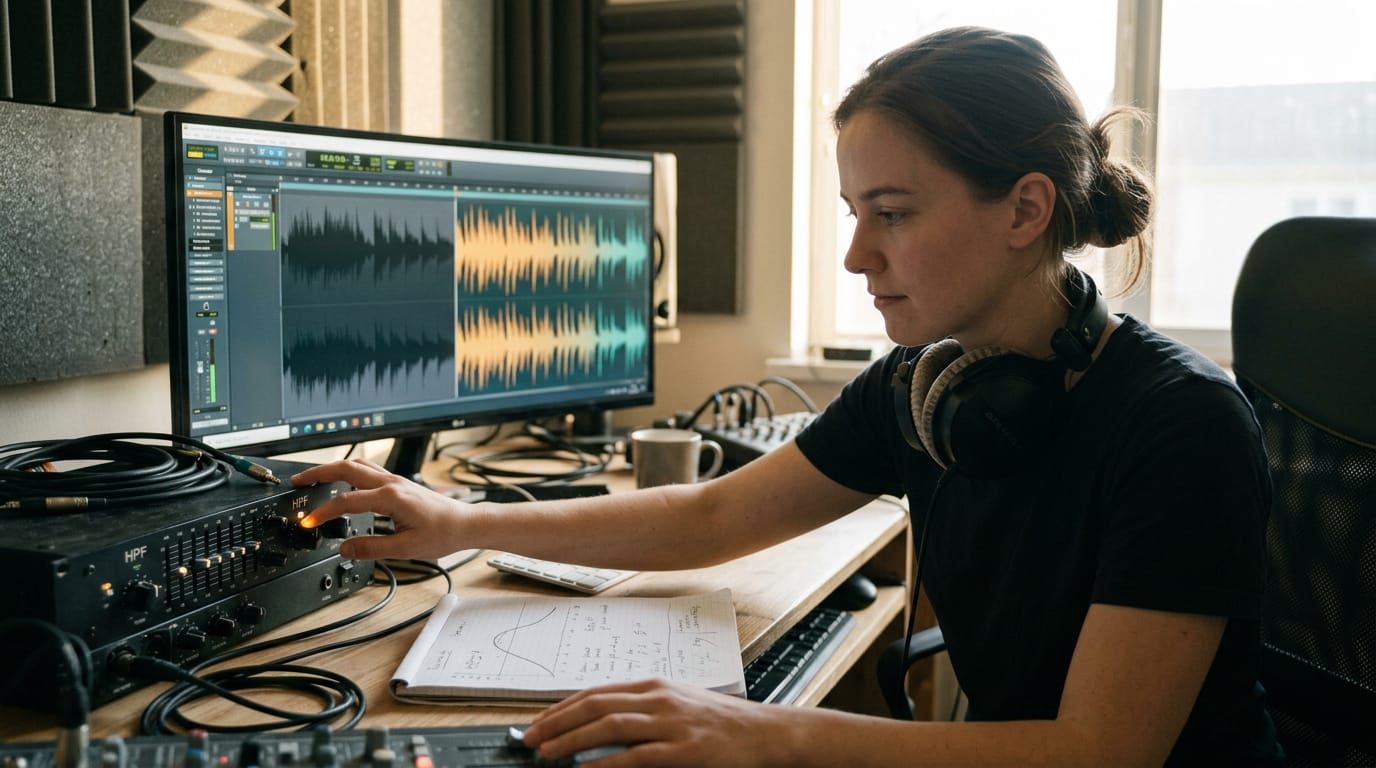
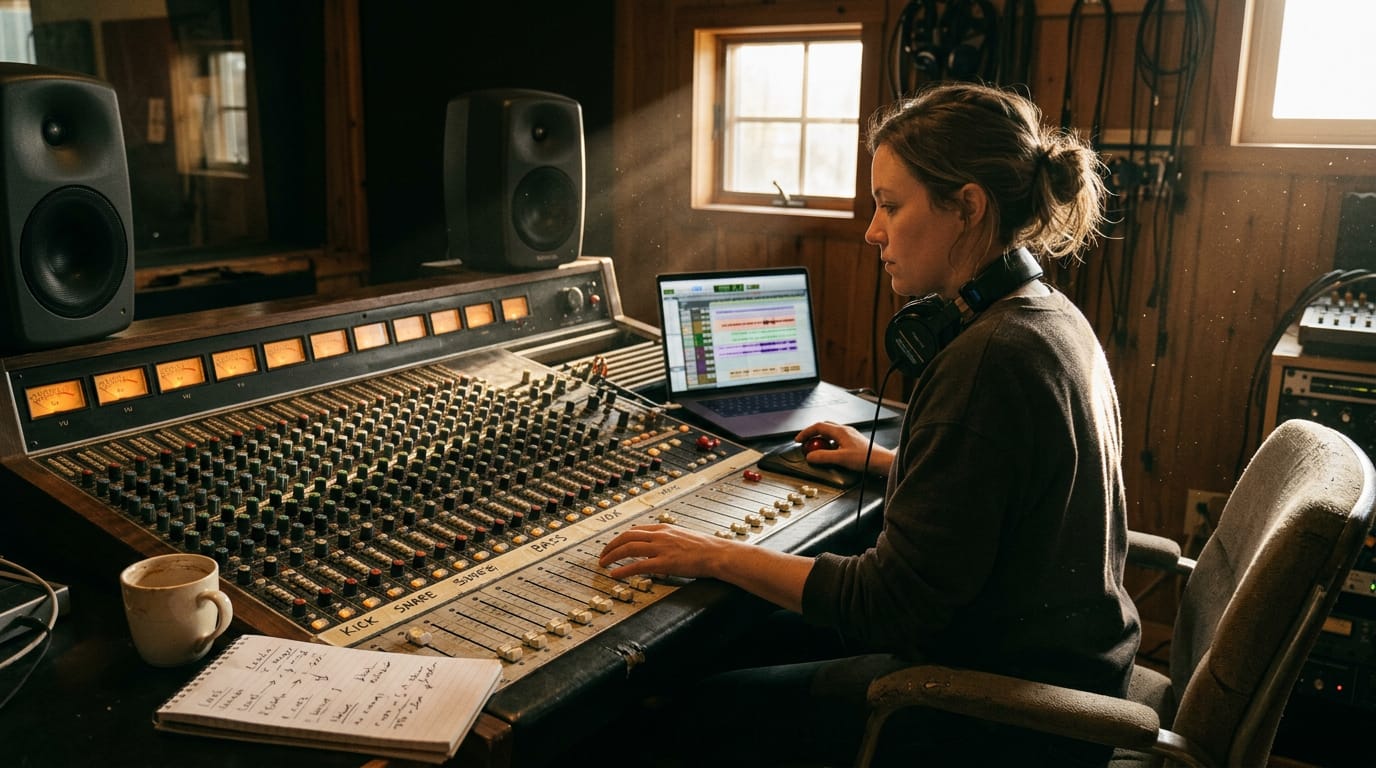
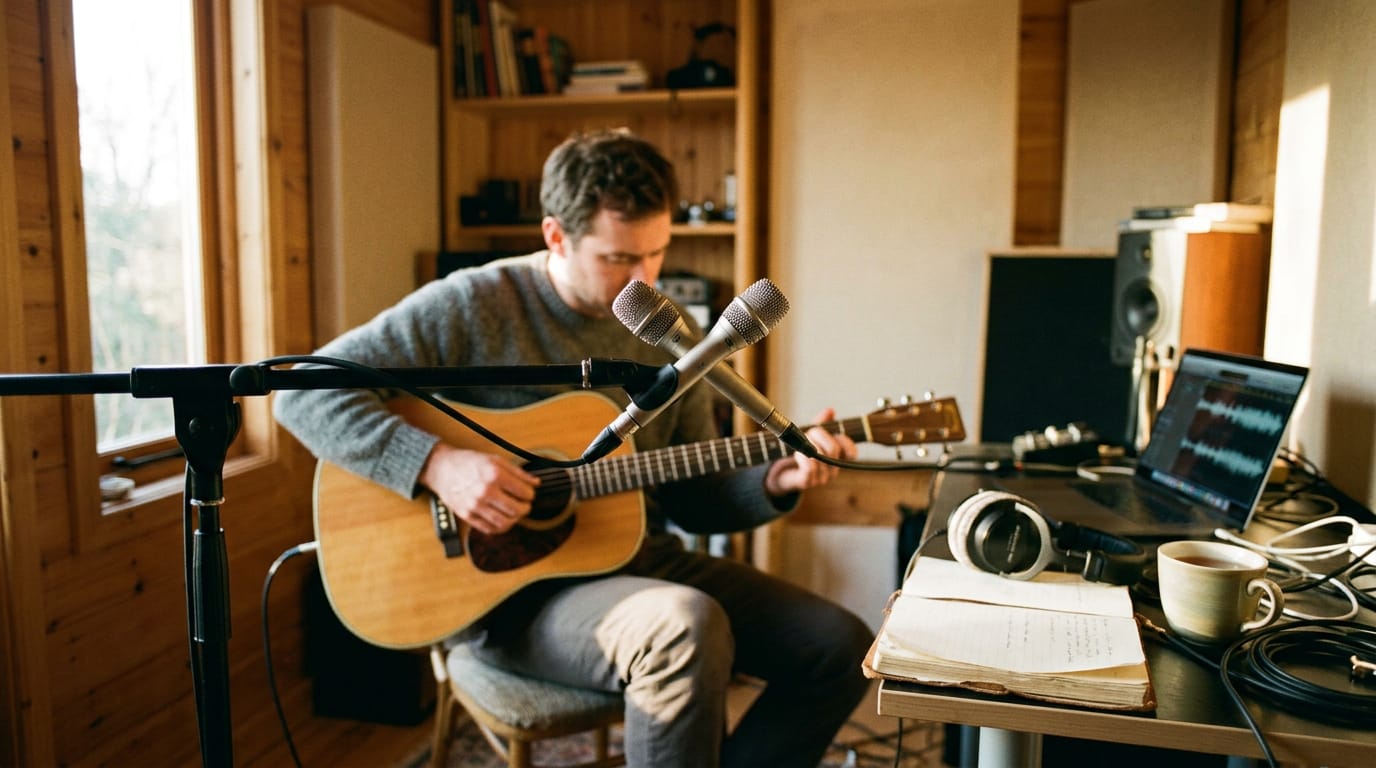
Immersive audio explained: what it is and how it works
Immersive audio surrounds you with sound from every direction. See how its formats, playback gear, and at-home recording and mixing work, step by step.


Chapters
In short
Immersive audio is sound designed to surround you from the front, sides, back, and above, rather than play across a flat left-to-right field. It places sounds in three-dimensional space, and playback systems adapt the mix to compatible speakers or headphones, so the effect depends on both the mix and your setup. For listeners, it can make music, films, and games feel more lifelike; creators should check playback compatibility and room conditions before investing in a mix.
Picture sitting in a park. A kid laughs somewhere behind you, a dog barks across the road, and wind moves through the trees overhead, all without anyone telling you where each sound is coming from.
Immersive audio works the same way. It’s sound that surrounds the listener from the front, sides, back, and above, so the scene feels like it’s happening around you instead of playing out in front of you.
This guide covers what it is, how it works, the formats and gear you’ll meet, and how to record or mix it from home.
What Immersive Audio Actually Is
Most recordings were built for a flat stage. Immersive audio places sound all around you, overhead included.
What does immersive audio experience mean?
Simply put, sound can come from any direction. Here’s how each format builds:
- Stereo: sound spreads left and right between two speakers.
- Surround: speakers wrap around you, so sound can come from behind.
- Immersive audio: height is added, so sound can come from overhead.
Surround works on a flat horizontal plane. Immersive audio builds on it as surround’s successor, adding the vertical dimension it’s missing. Where a sound comes from matters as much as what it is.
How the industry names and honors it
According to IAA’s look back at past Grammy winners, the Grammy category was renamed to use “immersive” terminology in 2019. 3D audio is another label for the same idea.
Names may be branding, but what’s changed underneath is technological: more directions, and more control over where sound lands.
Why listeners find it more lifelike
Sound from above adds depth, so scenes feel like they have real space. Fidelity, meaning how faithfully a recording keeps its detail, improves too: footsteps and breaths stay distinct instead of blurring together.
Think of a solo podcaster recording a rainy-night story in a spare bedroom. When she mixes it in immersive audio, the rain falls overhead while footsteps pass by one side, so listeners stop noticing their earbuds and start following the story.
Stereo still sounds good, but it’s the older reality: a single front-facing picture. Immersive audio feels closer to how sound reaches your ears, which is why listeners call it more lifelike.
How the Technology Behind Immersive Audio Works
Stereo is two fixed channels, left and right, so a mix is built for the speakers it plays through. Spatial audio flips that: each sound carries data about where it belongs, and the playback system figures out how to reproduce it.
How each sound gets its own position
Each sound carries location metadata, tags that place it in three-dimensional space. Dialogue can anchor to screen center while rain sits high and to the left, and sounds can move through the room.
Because positions are stored as data rather than locked to speakers, the same mix scales to any speaker count. A renderer, the software in the playback device, adapts it to your system.
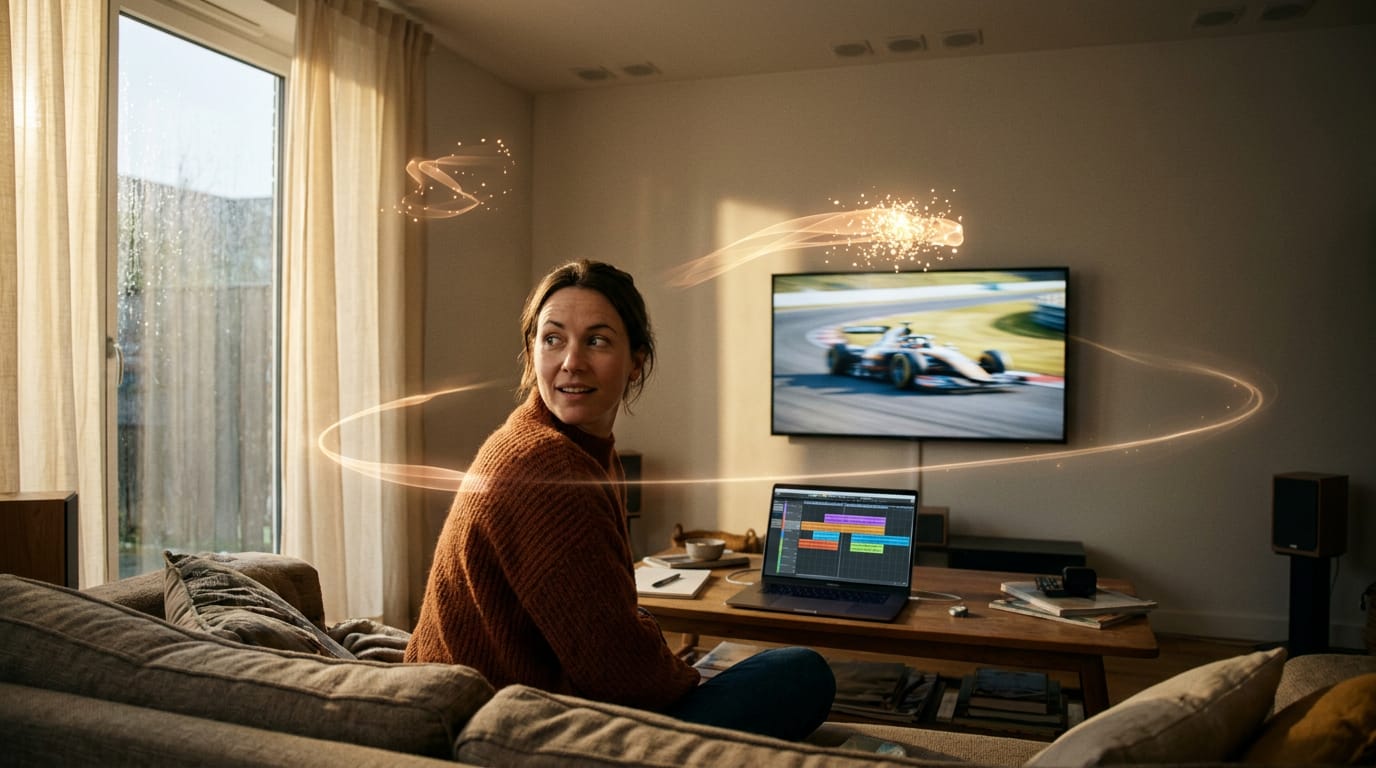
Consider a creator cutting a race car lap. In stereo, the engine roar slides across two speakers. In a spatial mix, the engine follows its own path from behind the viewer, so the car passes rather than just getting louder.
Speaker setups that add overhead height
Spatial mixes can add overhead speakers. Here’s how the two layouts break down:
- 5.1.4: five main speakers, one subwoofer for bass, and four height speakers above you.
- 7.1.4: seven main speakers, one subwoofer, and the same four height speakers.
According to WordUp News, home systems can run up to 34 speakers, though such a setup is usually unnecessary. The mix isn’t tied to any one layout.
Getting 360-degree sound through headphones
Headphones can build a 360-degree soundscape in ordinary stereo using HRTF modeling, short for head-related transfer function. The model captures how your head, ears and shoulders change sound before it reaches each eardrum.
The technique is also used on phones and portable speakers.
Creators can deliver a binaural mix, a two-channel file built with HRTF modeling for headphones. Picture a travel vlogger filming a busy market: the crowd seems to surround the viewer as she walks through it.
One soundtrack that plays on any setup
The same mix plays through basic TV speakers or a full home theater, and the renderer adapts it to what’s connected. A streamer who mixes a highlight reel once can share that one file with viewers on both.
Upgrade later, and the content stays the same. One mix, every room.
Formats, Codecs, and Decoders You’ll Meet
Immersive audio shows up under a lot of names, so here’s what you’ll meet and what to check.
Which immersive format sounds best?
- Dolby Atmos: Dolby’s immersive format.
- DTS:X and DTS:X Pro: DTS’s immersive family, including a Pro version.
- Auro-3D: A separate immersive format you’ll see listed beside the others.
- MPEG-H: An immersive format from the Moving Picture Experts Group.
So which is the highest quality of sound? Quality depends on the mix, the gear your listeners own, and the room. There’s no single winner.
The better question is less about which format sounds best on paper and more about whether your listeners can play it.
Checking that your gear can play it
Think of a codec (short for coder-decoder) as the packing method behind an audio file format. Your player has to know that method before the sound can come out.
A decoder does the unpacking. It often sits inside an AV receiver (audio-video receiver), the box that routes sound to your speakers.
Say you’re a podcaster mixing an episode in a spare bedroom. If a listener’s receiver can’t decode your format, they won’t hear the immersive mix you built.
You’ll also see Dolby Digital and Dolby Plus on spec sheets. Each receiver lists the formats it supports, so check that list before you buy.
DTS also offers higher bit rate versions. Bit rate measures how much data is used per second of audio. More of it can mean more detail, but also bigger files.
Setting up Your Playback Hardware
Your playback gear decides how much of an immersive mix you actually hear. Start with what plays it.
Choosing between a receiver and soundbar
An AV (audio-video) receiver processes and amplifies the signal for speakers. An AV preamp, in some setups, handles the rendering: building each speaker’s sound.
A soundbar without a receiver is simpler and suits a desk. Think of a streamer who wants overhead rain in a game but hears it stay mostly in front.
Before you buy, check that your TV and device both support ARC (Audio Return Channel), the HDMI (High-Definition Multimedia Interface) feature that sends TV sound back to your soundbar or receiver over a single cable.

Playing it on a computer or app
- Windows spatial audio: a processing mode that places sound around you.
- Dolby Access app: this is where you’ll set up Dolby formats on Windows.
- Speakers or headphones: The 83% rule is a speaker-setup guideline. According to a mixing guide from SK Records, speakers should sit at 83% of your room length from the back wall. It’s about where they sit, not what they cost. Headphones skip room placement entirely.
Room acoustics matter too, since hard walls bounce sound and blur the height cues that make immersion work. A musician mixing in a spare room hears thin, echoey sound from above until a rug and curtains tame the bounce.
Which disc players and consoles support it
- Blu-ray and Digital Versatile Disc (DVD) players: Check the specs before assuming yours handles it.
- FLAC playback: Free Lossless Audio Codec (FLAC) files keep full quality, so confirm your player reads them.
- PlayStation 4 (PS4) and Xbox One: Test a title you know before relying on either console.
- Specific LG, Sony, and Panasonic models: Support varies by model, even within one brand, so look up the exact player you’re considering.
Physical discs and the players they need
- DSD encoding: Direct Stream Digital (DSD) is an encoding method your player must decode.
- SACD player required: Super Audio CD (SACD) discs need a player that reads their high-resolution layer.
- Six-channel mixes: They carry six speaker feeds, so your player and receiver must handle all six.
- Blu-ray Audio releases: These need a Blu-ray player that supports high-resolution audio.
The disc holds the mix, but the player decides what you hear. Check both before you buy.
Where Immersive Audio Shows up in Practice
Immersive audio has already moved well past the lab, and you’ve probably heard it in movie theaters, games, and albums.
How cinemas and games pushed it forward
Surround sound has its roots in cinema, where extra speakers let sound move with the action. IMAX and other advanced screens pushed that further with bigger, more detailed systems.
Blockbuster sound effects, like a helicopter passing overhead, showed what placement could do. Gaming drives innovation even harder. Picture a streamer who hears footsteps behind her and turns before the enemy reaches the door.
That sound follows you instead of simply playing at you.
Albums already mixed in immersive sound
Music has its own growing catalog. The Grammys now include an immersive audio category, and releases keep climbing. Many albums ship in Dolby Atmos editions, and Blu-ray Audio releases offer another way to hear them. You’ll find immersive mixes across:
- classical
- rock
- electronic catalogs
Consider an indie producer mixing a rock record at home: the vocals stay centered while the guitars swirl around you. Stereo places the band between two speakers, while immersive places it around you.
Where home systems are headed
Home systems are becoming common, and growth is predicted as more listeners set them up. Setups are also simplifying, so you don’t need a full room of speakers to get the effect.
Picture a podcaster in a spare bedroom who wants an immersive mix on a small desk. Simpler configurations let her get there without building a dedicated theater. That’s the home theater escape.
Immersive sound leaves the big room and shows up wherever people already listen.
How Producers Mix Immersive Content
Immersive mixing asks for different instincts than stereo. Here’s what changes at the desk, and what it costs.
New creative room for sound engineers
In stereo, you pan a sound left or right between two speakers. In immersive mixing, you pan it in three dimensions, so it can sit above or behind the listener. Each sound becomes an object with its own position. Balancing many positioned objects in one mix is a craft of its own, and professional audio mixing is the next step.
For artists, that’s a new canvas: a rainstorm can drift overhead, or a vocal can circle the room. Recording for it is harder, too, since you have to capture where sounds come from, not just what they sound like.
Dolby Atmos includes monitoring tools that let you hear the mix the way a listener will, and creators can audition it on headphones.
Think of a podcaster building a spatial intro at her kitchen table: she gets the effect without building a studio, then checks the final version on speakers when she can.

Why good mixes take time and money
Every sound you place in space is another decision, so the work adds up fast:
- Higher time and cost. Each placement and move takes more work, so budget for it early.
- Static ceiling-object shortcuts. Parking a sound at a fixed spot overhead saves time, but it trades movement for speed. Movement is the whole point.
- Preprint mixes. These are finished ahead of time as fixed files, so they can’t adapt to each listener’s setup.
- Object viewer reveals quality. It shows where each sound sits over time, so a parked sound or a jumpy move is easy to spot.
- Consumer pushback. Listeners can resist paying extra when they can’t hear the difference. Before you start, check which delivery platforms and streaming services accept immersive files, since a mix nobody can play back won’t win anyone over.
How Audio Formats Evolved over Time
Immersive audio is the newest step in a long run of experiments with where sound comes from. We’ll walk through how that path unfolded.
How sound moved from mono to stereo
Early recordings used mono, one channel sent through one speaker. Stereo gave sound two paths instead of one, creating a stereo field where instruments sit across the room.
A paper on fixing the phantom center explains that when two loudspeakers play the same signal, a phantom center image forms between them. No speaker sits there.
Think of a podcaster mixing her voice in a spare room. Center it, and listeners hear her clearly right between the speakers. The Sinatra center-mixing anecdote is another reminder of why the middle matters.
Key moments in surround sound history
Fantasia’s 1940s experiments explored sound spread across more than one speaker. In 1957, Henry Jacobs’s planetarium work added another early chapter.
According to the Engineering and Technology History Wiki, Dolby Laboratories introduced Dolby Stereo in 1975 for motion picture producers and theaters.
A study on the transition to Dolby sound in Hollywood cinema shows it was used in films during the 1970s.
How surround channel layouts took shape
Surround layouts grew from there. A 5.1 layout uses five full-range speakers and one low-frequency effects (LFE) channel, while a 7.1 layout adds two more full-range speakers. Here’s where they sit:
- Front: left, center, and right speakers
- Side and rear: surrounds that wrap sound around the listener
- LFE subwoofer channel: carries the deep bass a subwoofer reproduces
More channels, more angles. Every added speaker gives sound another direction to come from, which is why the newest layouts feel so enveloping when you’re sitting in the middle of them.
Immersive audio comes down to placement. Instead of sound coming from two speakers in front of you, it comes from all around you, which is what makes a scene feel real.
You don’t need a studio to begin. Work with the room you have, learn the formats and gear that fit your setup, and listen closely to what you hear.
The best immersive mix is the one where your listeners stop thinking about the speakers.
References
- Making films sound better: the transition to Dolby sound in Hollywood cinema — doi.org (2005)
- Looking Back: Past Grammy Winners & Nominees for Best Immersive Audio Album — immersiveaudioalbum.com (2026)
- What is Dolby Atmos? All you need to know — wordupnews.com (2026)
- How to Find the Mixing Sweet Spot Using the 38% Rule 2026? — skrecords.org (2026)
- Dolby Laboratories — ethw.org (2026)
- Fixing the Phantom Center: Diffusing Acoustical Crosstalk — audioroundtable.com
Questions
What is the 83% rule for speakers?
The 83% rule is a speaker-placement guideline: position speakers about 83% of the room’s length from the back wall. It concerns where speakers sit in the room, not their price or sound quality.
What is the difference between stereo and spatial audio?
Stereo plays sound across two channels, left and right, creating a flat field in front of the listener. Spatial audio assigns sounds positions in three-dimensional space, and the playback system renders them for the available speakers or headphones.
What does "immersive audio experience" mean?
An immersive audio experience makes sound seem to come from around and above the listener, rather than only from in front. By adding depth and directional placement, it can make a scene feel more lifelike.
Which is the highest quality of sound?
There is no single highest-quality sound format for every listener. Sound quality depends on the mix, playback equipment, and room, as well as whether the listener’s system supports the format.
Sources
- Looking Back: Past Grammy Winners & Nominees for Best Immersive Audio Album | IAA, immersiveaudioalbum.com,
- Fixing the Phantom Center: Diffusing Acoustical Crosstalk, audioroundtable.com
- Dolby Laboratories - Engineering and Technology History Wiki, ethw.org,
- Making films sound better: the transition to Dolby sound in Hollywood cinema, doi.org,
- What is Dolby Atmos? All you need to know – WordUp News, wordupnews.com,
- How to Find the Mixing Sweet Spot Using the 38% Rule 2026?, skrecords.org,