How to Write a Video Script From Start to Finish
How to write a video script that holds attention: plan the flow, shape a strong opening, revise with the three C’s, and turn your draft into footage at home.

Chapters
In short
A video script is a written plan for what you say and show, from the opening line to the final call to action. To write one, choose a specific viewer, define one clear message and goal, then shape a strong hook, focused middle, and relevant ending; include dialogue, visuals, and filming or editing notes. Read it aloud, time and revise it until it sounds natural, so filming stays organized and viewers can follow the point.
Think about explaining something to a friend across the table. You wouldn’t just start talking. You’d work out what to say first and where the good part belongs. A video script works the same way, except your listener can click away in seconds.
A video script is the written plan for what you’ll say and show on camera, from the opening line to the final call to action.
This guide covers planning, structure, hooks, revision, and help from artificial intelligence (AI) tools, plus the steps that turn your script into footage you can film at home.
How to Write a Video Script
Many YouTubers do write scripts, including plenty who sound effortlessly casual on camera. That relaxed feel usually comes from a plan, not from winging it.
Why scripting first makes filming easier
A script gives you a map before you hit record. Here’s what it does for your shoot:
- Keeps the shoot organized. You know the next shot before you set up the camera.
- Saves editing time. Planned takes mean less digging through footage.
- Controls length and budget. Timing each section tells you the final length and how many setup sessions you’ll need.
- Sparks ideas. Writing a hook on paper often shows you a sharper angle.
- Keeps the message focused. A clear outline keeps tangents from diluting your point.
The goal is to be prepared rather than rehearsed, so your delivery still sounds like you. Consider a solo podcaster filming a gear review in her spare bedroom.
Her script orders the unboxing before the close-ups, so the window light holds steady all session. She’s done in one afternoon, not two.
What goes into every script
A useful script usually covers five things, each answering a question you’d otherwise face mid-shoot:
- Voiceover and dialogue. The words you say, or the lines your guests deliver.
- Visual descriptions. What the viewer sees on screen at each moment.
- Filming instructions. Camera angle, framing, and movement for every shot.
- Editing instructions. Cuts, text overlays, and where music drops in.
- Scene and prop notes. The location, the lighting setup, and what needs to be on set.
What YouTube script writers earn varies too widely for one number to mean much, since it depends on the project and who’s hiring.
Planning Before You Start Writing
Before you write a line of dialogue, settle who’s watching, what the video should accomplish, how it should feel, and what viewers do next. Those answers turn a blank page into a plan.
Choose one specific viewer to target
Aim for one person, not “everyone.” Picture a home podcaster filming in a converted closet, wondering why her episodes look flatter than the shows she binges.
Her frustrations tell you what to explain and which tone to use: friendly and practical, not a lecture from someone with a studio.
Set your goal and main message
Decide what the video should do: teach, sell, entertain, or grow your list. Then write your main message in one sentence. If you can’t say it that briefly, the script will wander, so aim for clarity over cleverness.
Next, note your brand promise (the commitment you keep every time) or your unique selling proposition (USP). Mark your funnel stage, meaning where the viewer sits on the path from discovering you to buying.
Pick your key performance indicators (KPIs), like watch time or sign-ups, so you can tell whether it worked. Without a number, you’re only guessing. If watch time is the number you care about most, see how to grow your YouTube channel fast, step by step.
Choose the feelings and main character
Decide how you want viewers to feel by the final frame:
- confident
- curious
- relieved
Those feelings steer your word choice, pacing, and music. A streamer hoping newcomers feel relieved, not overwhelmed, keeps sentences short and skips the jargon. Then pick your central character, the person or problem the story revolves around. After you pick the music, adding music to video comes next, so it doesn’t overpower your voice.
If you’re on camera, you’re also the consistent spokesperson, so keep the same voice and energy from video to video. Same host, same warmth, every time.

Settle on your call to action early
Your call to action (CTA) is the one thing you want viewers to do next, and it should match the video’s purpose. A video meant to grow an email list needs a sign-up prompt, while one promoting a course needs a link to it.
Pick the action before you write, so every line leads there. Decide now, and your closing line has somewhere to land.
Shaping the Flow of Your Script
Your script’s shape decides whether viewers stay. Here’s how to order it, detail it, and open strong.
Use a beginning, middle, and end
- Intro grabs attention: Open with what the viewer wants, not your backstory.
- Problem, then solution: Name the frustration, then show the fix.
- Conclusion with CTA: Close with a call to action (CTA), like asking viewers to subscribe.
- Main point up front: Put your biggest idea early, not last.
A home-office coach opens her pricing lesson with the problem, then shows the fix.
Choose how detailed your script is
- Detailed script: Every word written out, ideal for a first-timer.
- Bullet-point outline: Key beats in order, with the wording left to you.
- Two-column audio/visual table: Audio on the left, visuals on the right, so each line matches its shot.
- Sample script template: Fill-in slots for hook, problem, solution, and CTA.
- Group scenes by lighting setup: Film shots that share one light back to back.
A podcaster in a converted closet writes her intro word for word, then films every shot with the same softbox in one session. No re-shoots.
Hook viewers in the first seconds
Your hook must earn the rest of the video.
- Only 3 seconds: Viewers decide fast, so lead with the payoff, not the setup.
- Intriguing intro: A study of viral TikTok hooks, The Science of the First Three Seconds, notes that an intriguing opening, such as a question or surprising fact, can help capture attention.
- Ask a question: Pose the one your viewer is already asking.
- Reaction sound: Open on a quick laugh or a surprised ‘wait, what?’
- Surprising fact: Lead with a result that makes people blink.
A streamer opens with ‘Why do you look washed out on camera?’ and shows the one-light fix within seconds, so viewers stay.
What Are the Three C’s of Writing a Good Script?
Most strong scripts come down to three C’s:
- conversational
- captivating
- concise
Here’s how each one works on the page.
Write the way you actually talk
Write it to be heard, not read. If a line sounds stiff out loud, rewrite it the way you’d explain it to a friend over coffee. Speak directly to the viewer with “you,” keep words simple, and skip jargon.
Stick to the present tense where you can: “You open the blinds” lands harder than “you will have opened the blinds.” Picture a course creator whose first draft reads like a textbook.
Once she rewrites it as if talking to one student, her takes run smoothly with far fewer re-shoots.

Use story tricks that keep people watching
An empirical study on narrative reports that stories are engaging and aid comprehension and retention.
Build yours around a named main character with a real problem, like Dana, a streamer whose face goes dark every evening once the sun sets, so viewers spot their own problem in the first line.
Hold back the answer for suspense, describe what viewers can picture to trigger imagination, and name the relief of a clean frame to amplify emotion.
Keep it short and cut the extras
Give each script one idea. Three big points means three scripts, not one crowded one. Use short sentences, and cut any line that repeats what you’ve already said. Write the full draft, then trim.
For words-per-minute guidance, read it aloud with a timer, because the clock shows whether it fits your slot.
Pacing matters for retention too, so add a pattern interrupt now and then, like a question to the viewer or a quick change of angle, to reset attention before it drifts.
Plan for viewers who watch muted
Many viewers watch with the sound off, so the script must carry meaning visually. Write visual cues into the lines, like “(on screen: the three-step checklist appears),” so the editor knows what to show.
Subtitles help here: a paper on video captions notes that captions can translate sound effects, name who is speaking, and mark off-screen voices in italics.
Even a silent segment needs a script. Walking through your desk setup with no narration? List each shot, any on-screen text, and what viewers should notice, so the picture carries the story, not the narration.
Polishing and Sticking to Your Draft
Once the draft is written, the work shifts to polishing it, testing it, and sticking to it on camera.
Read it aloud and time it
Reading your script out loud catches clunky sentences fast, and anything that trips your tongue will trip your audience’s ears too. Time the full read with your phone, then rehearse with a small group to hear how the lines land.
If you’ll read from a teleprompter, set the scroll to your natural pace and break the text into short phrases so you sound conversational, not robotic.
Consider a streamer who times her opening and finds she’s been talking for almost a minute before getting to the point. She cuts it, so the hook lands within the first few seconds.
Revise and get honest feedback
Most scripts need several drafts, so give each pass one goal and aim for progress rather than perfection. Ask a peer or teacher for specific notes, like ‘Where did you lose interest?’
Have an outsider proofread, since they’ll catch typos you’ve stopped seeing. Finally, score the draft against a judging rubric, a simple checklist covering hook, clarity, and pacing.
Stick to the script while filming
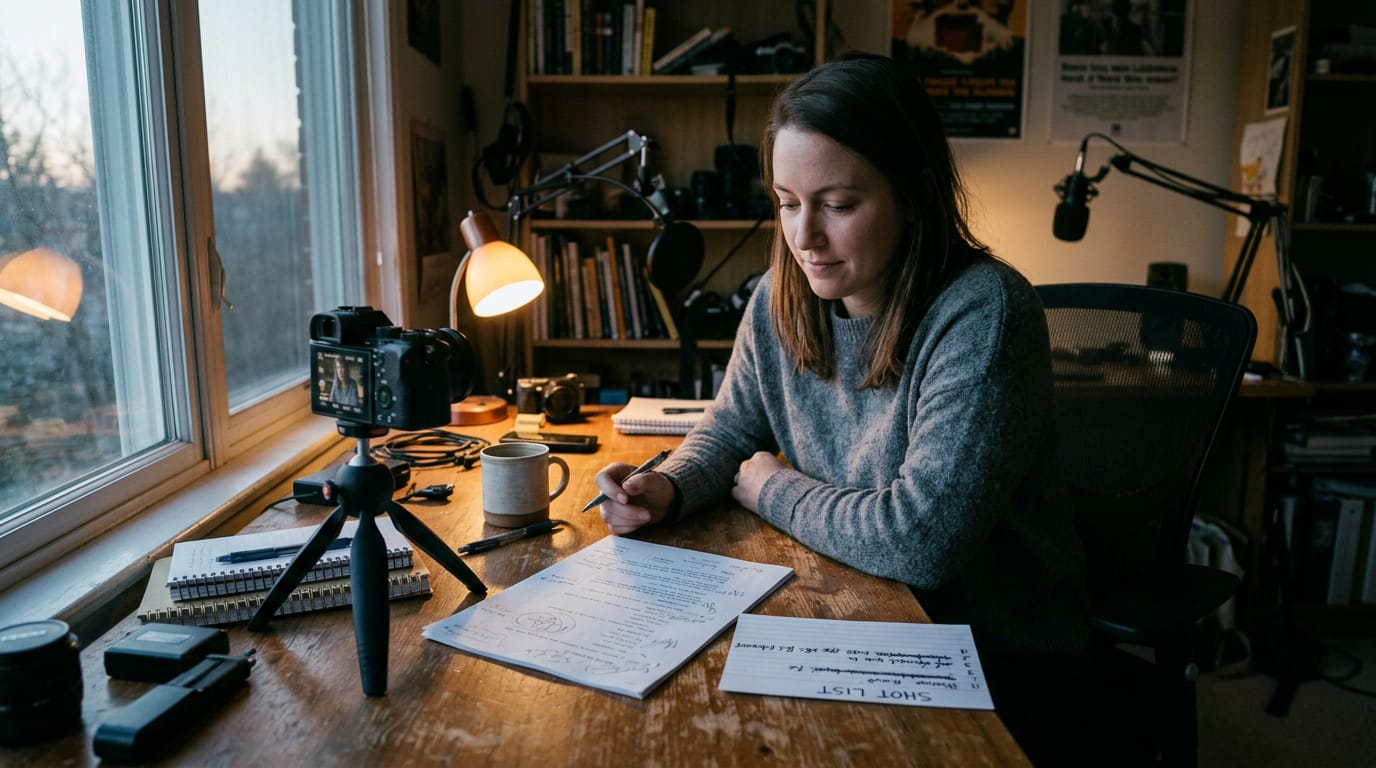
Once filming starts, follow the script closely and avoid ad-libbing, since improvising pulls you off topic. Before you press record, turn the script into a shot list noting what the camera shows for each line.
If resources change, rewrite the affected lines rather than forcing the original. A solo creator who loses window light mid-week might swap that segment for a desk demo under a lamp. The message stays intact. Your deadline does too.
Types of Scripts, with Real Examples
Not every script does the same job, so match the structure to the goal.
Scripts that teach and explain clearly
An explainer walks viewers through one idea from start to finish, with a visual for nearly every point.
Break content into chunks, one idea per segment. Three small steps are easier to follow than one long paragraph.
Filming alone in a small room? Picture a podcaster who writes each chunk on its own index card, glancing down, then back at the lens. Write for speaking rather than reading.
Use Mint and Dollar Shave Club as pacing references for your own outline.
Scripts that persuade with promos and ads
Promo and commercial videos exist to get viewers to act. Show benefits over features, and name your differentiators, the things that set you apart.
A call to action (CTA) is mandatory. Without one, even a great spot just entertains. Study the Oreo and Burger King spots in your research and note the hook in each.
Consider a wedding videographer selling a weekend package. Her script opens on the first look, names the benefit (a film to share with family), and closes with: ‘Book your date before it’s gone.’
Sample scripts for common video types
An animated explainer needs narration-first writing. Pair each one-line scene with its voiceover so the artist knows exactly what to draw.
Share interview questions ahead as topics, not a word-for-word script. A real estate agent can send three prompts the night before so the homeowner isn’t caught off guard.
A testimonial is mostly the customer’s own words, so ask good questions and edit lightly. A case study follows a problem, the fix, and the result.
Using AI and Templates to Script Faster
Most scripts stall on the blank page, so here are the AI tools and templates that help you get past it without losing your voice.
Tools that draft a script with AI
Start with an AI first draft. Give an AI tool your topic and target length, and it returns a rough script.
Consider a streamer with a two-minute channel intro to film before a weekend stream: the draft gives structure fast, and they rewrite it until it sounds like how they actually talk. Treat it as a starting point, not a finished script.
ChatGPT is a general chatbot, so you can refine the draft by asking for changes, such as a tighter opening or a 90-second cut. Biteable AVA and the PlayPlay AI script generator are two more options.
Run the same topic through each and keep the draft that needs the fewest edits to sound like you.
Ready-made templates and handy tools
Ready-made templates give you the sections in order, so you only fill in the words. A real estate agent filming a listing walkthrough can reuse one layout for every new house and change only the details.
Template collections group layouts by format, such as tutorials or product reviews, so you aren’t starting from nothing. Project organizer resources keep scripts, shot notes, and footage in one spot. Tutorials count as instructional video, so plan each step before you film.
A storyboard is a row of rough sketches, one per shot. Use a storyboard guide to sketch each scene with a line for the words you’ll say, so you can spot a slow stretch before you set up the camera. Templates handle the layout. Your voice does the rest.
A strong script gives you a clear path from the first line to the last, so you can spend your energy on delivery instead of wondering what comes next. Plan for the viewer, shape the flow, and revise until the words sound like you talking to one person.
The page is your map, not a rulebook. Read it out loud, adjust whatever sounds stiff, and then hit record. The words get you started, and your voice does the rest.
References
- The Science of the First Three Seconds: An Empirical Analysis of Emotional Tone, Rhetorical Style, and Category Norms in Viral TikTok Hooks — doi.org (2025)
- Can narrative help people engage with and understand information without being persuasive? An empirical study — pmc.ncbi.nlm.nih.gov (2024)
- Video Captions Benefit Everyone — pmc.ncbi.nlm.nih.gov (2015)
Questions
What are the three C's of writing a good script?
The three C’s of writing a good script are conversational, captivating, and concise. Write in a natural speaking voice, keep viewers interested with a clear story or hook, and focus on one idea without unnecessary lines.
How much do YouTube script writers get paid?
YouTube script writers’ pay varies widely depending on the project and who hires them. Rates can differ based on factors such as script length, complexity, and the writer’s experience, so there is no single typical amount.
Do YouTubers write scripts for their videos?
Yes, many YouTubers write scripts, including creators whose delivery sounds casual. They may write every word or use an outline, helping them stay focused and organize filming while keeping their delivery natural.
Can ChatGPT write a YouTube script?
Yes. ChatGPT can draft a YouTube script from a topic and target length, and you can ask it to revise the opening, shorten the script, or make other changes. Treat its output as a starting point and edit it so it is accurate and sounds like you.
Sources
- The Science of the First Three Seconds: An Empirical Analysis of Emotional Tone, Rhetorical Style, and Category Norms in Viral TikTok Hooks, doi.org,
- Can narrative help people engage with and understand information without being persuasive? An empirical study, pmc.ncbi.nlm.nih.gov,
- Video Captions Benefit Everyone - PMC, pmc.ncbi.nlm.nih.gov,